Who owns the equipment in a nursing home?
Much of the equipment in a nursing home belongs to someone else. The LTC pharmacy usually owns the med carts, e-kits and fax machine. A DME company owns the specialty beds, a therapy contractor the rehab machines, and a laundry or ice vendor the machines in the back. Staff can’t always tell which is which, so problems get reported to the wrong company, or to nobody.
By ServiceTagsUpdated 7 min read
Who owns what in a typical nursing home?
Ownership follows the contract. The facility owns the building and what it bought outright. Vendors own what they place there to deliver a service: the pharmacy’s carts, the DME company’s beds, the laundry operator’s washers. Whoever owns a piece of equipment is usually the one who has to fix it.
| Equipment | Usually owned and fixed by | Notes |
|---|---|---|
| Med carts, treatment carts and IV carts | LTC pharmacy | Placed by the pharmacy that supplies the medications. The pharmacy fixes locks, keys and drawers. |
| Emergency drug kits (e-kits), dispensing cabinets, fridge lock boxes | LTC pharmacy | Small, easy to overlook, and often the first thing nobody has tagged. |
| Fax machines, scanners, laptop arms on carts | LTC pharmacy | Order-entry equipment the pharmacy places so the facility can send orders. |
| Crash carts | Varies | Some belong to the pharmacy, some to the facility. Check before you call. |
| Therapy machines: electrical stimulation, ultrasound, exercise cycles | Rehab or therapy equipment program | The vendor maintains and calibrates them. |
| Specialty beds and mattresses, bariatric equipment, wound vacs, respiratory equipment | DME rental company | Rented per resident and moved often. The vendor cleans, maintains and repairs. |
| IV and infusion pumps | Infusion pharmacy or pump rental company | The vendor calibrates and maintains them. |
| Feeding pumps | Nutrition supplier | Placed under a supply contract. |
| Dialysis machines | On-site dialysis provider | The provider’s own staff are often in the building. |
| Washers and dryers | Laundry route operator | Owned and maintained by the operator. |
| Ice machines and dispensers | Ice machine subscription vendor | Repairs are part of the subscription. |
| The building, its systems, furniture and standard beds | The facility | Fixed by the facility’s own maintenance staff or its contractors. |
This is a map of common arrangements, put together from vendor materials we reviewed in November 2026. It isn’t a survey, and contracts differ. When in doubt, the service agreement decides.
Why do staff report equipment to the wrong vendor?
Because most equipment doesn’t say whose it is or where to report a problem, and a lot of it looks alike. A nurse with a drawer that won’t lock calls whoever seems most likely. Usually that’s the pharmacy.
- A single hall can hold med carts, treatment carts and a crash cart with different owners.
- A facility that has changed pharmacies, or uses a second one, can have two pharmacies’ carts in the same building.
- Agency and newer staff haven’t learned which vendor covers what, and nobody writes it down where they can see it.
- Orders and deliveries put the pharmacy in front of staff daily, so it gets the call for anything that looks like the pharmacy’s.
What it looks like in one pharmacy’s requests
We searched the request titles and notes of one regional LTC pharmacy that uses ServiceTags. About 50 requests turned out to be about equipment the pharmacy didn’t own, and 6 were titled things like “Not our cart” or “Wrong pharmacy.” Notes from the pharmacy’s own staff:
- “Not our cart, brand name unknown.”
- “Facility owned crash cart that just needs new lock.”
- “This box is facility owned.”
- “Toner issue, but not our fax machine.”
- “Fax machine is not ours. Unsure how one of our QR codes ended up on it.”
The last one matters. One of the pharmacy’s tags ended up on another company’s fax machine. A tag only helps when it’s on the right equipment.
What does a report sent to the wrong vendor cost?
Time for the company that gets it, and downtime for the equipment, because the company that owns it never hears about it.
- The vendor who gets the report triages it, sometimes sends someone, and then closes it as not theirs.
- The owner doesn’t hear about it, so the bed stays down or the drawer stays unlocked until someone tries again.
- The facility sees a slow fix. It doesn’t always know which vendor dropped it, and the one it called gets the blame.
Where does the facility’s own maintenance staff fit in?
They’re a second set of hands, and the split varies by facility. In the same pharmacy’s requests, 34 mention the facility’s maintenance staff.
The usual pattern: the pharmacy ships a part, and the facility’s maintenance installs it. Some facilities won’t let their maintenance staff touch a vendor’s carts at all. Neither is wrong, but each facility should know which one applies before something breaks.
What can a vendor do about it?
Put the answer on the equipment. Every piece you place should say it’s yours and how to report a problem, in a form a nurse can act on in seconds.
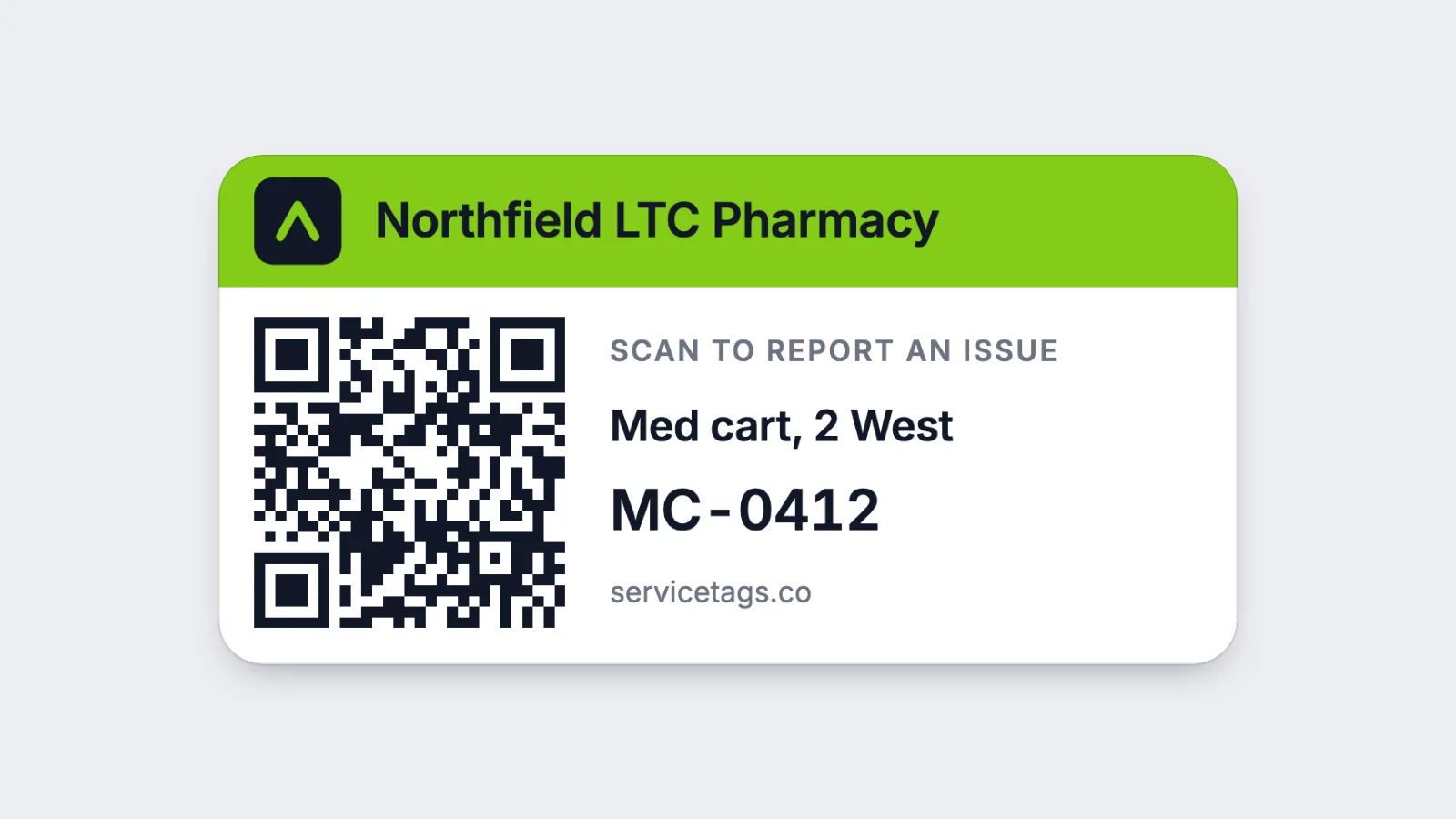
- Put ownership on the equipment itself. A tag with your name and a way to report reaches the person standing at the cart. The contract doesn’t.
- Tag the small things too. Lock boxes, e-kits, fridge lock boxes and laptop arms break and get reported too. In the same pharmacy’s requests, about 275 mention lock boxes and narcotics boxes and about 100 mention laptop arms and brackets on carts: equipment it owned but hadn’t tagged.
- Make reporting take seconds. No app, no account. Of that pharmacy’s 4,068 public requests, 87% were filed without signing in. See the 2026 request data for the rest.
- Plan for the reports that aren’t yours. You’ll still get some. Close them as not yours, and point the reporter to the right vendor if you know who it is.
- Check tags when they go on. A tag on the wrong machine sends reports to the wrong company, which is the problem you set out to fix.
- Agree the maintenance split with each facility. Write down which repairs the facility’s maintenance staff can do with your parts, and which ones wait for your tech.
Where ServiceTags fits
ServiceTags does the first three for vendors who place equipment in care facilities. Each asset gets a QR tag linked to your company and the facility it’s at. Staff scan it with a phone camera, pick the problem, and the request goes to the team that covers that facility. Nobody downloads an app or signs in.
It won’t stop staff from reporting equipment that isn’t yours. It also doesn’t track where equipment is in real time. It records the facility each asset is assigned to, and every request filed on it.